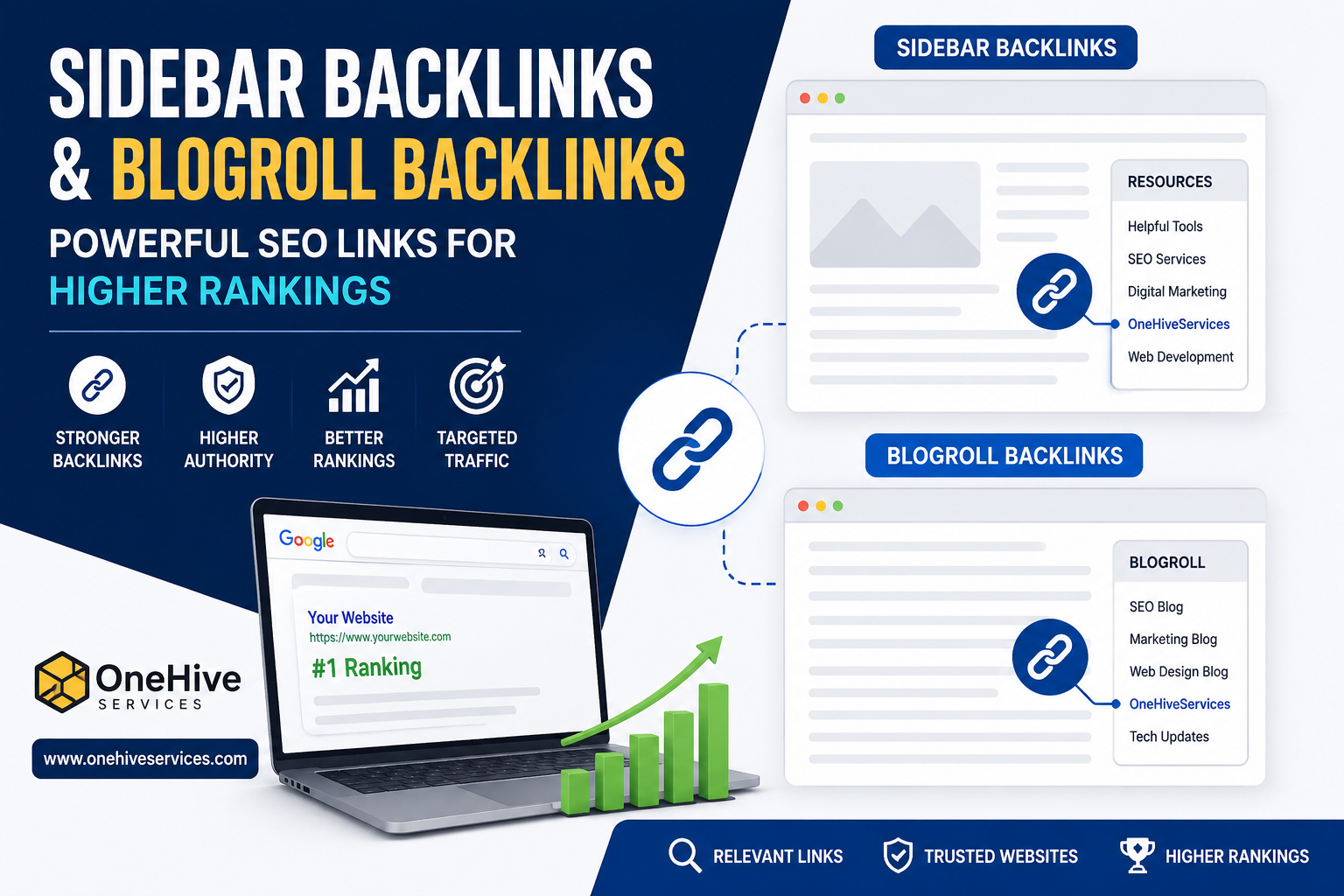
Sidebar backlinks and blogroll backlinks have been part of SEO for many years. Yet they still create a lot of debate. Some website owners see them as strong authority links. Others worry that sitewide links may look unnatural to Google.
The truth sits somewhere in the middle.
A backlink does not become valuable just because it appears on hundreds of pages. Its value depends on the website, relevance, placement, anchor text, and reason for the link.
At OneHiveServices, we focus on these factors when working with link placements. A good backlink should make sense on the page and fit into a wider SEO strategy.
This article explains how sidebar and blogroll links work, when they can help, and what website owners should check before using them.
What Are Sidebar Backlinks?
Sidebar backlinks are links placed in the side section of a website. They may appear on one page or across many pages. When the same sidebar appears sitewide, one placement can create links from many URLs.
You may see sidebar links beside:
- Blog articles
- Recent posts
- Categories
- Author information
- Recommended websites
- Partner resources
- Useful tools
For example, a marketing blog may have a section called Recommended SEO Resources. If an SEO company appears there, the link has a clear connection to the website’s topic.
That context matters.
A random casino link on a cooking blog would make much less sense.
What Are Blogroll Backlinks?
Blogroll backlinks are links placed in a list of recommended blogs, websites, partners, or resources. They often appear in a website’s sidebar or footer and may appear across the whole site.
Blogrolls were very common in the early days of blogging.
Blog owners used them to recommend other sites they liked. Although website designs have changed, the basic idea still exists.
Today, you may see similar sections named:
Recommended Sites
Our Partners
Useful Resources
Blogs We Read
Industry Resources
The label may change, but the concept remains similar.
Sidebar Backlinks vs. Blogroll Backlinks
People often use these two terms as if they mean the same thing. However, there is a small difference.
A sidebar backlink describes the location of a link.
A blogroll backlink describes the type or purpose of the link.
For example, a website could place a list of recommended blogs in its sidebar. In this case, the links are both sidebar backlinks and blogroll backlinks.
However, a sidebar may also contain a single sponsor, partner, tool, or resource link. That would be a sidebar link but not always a traditional blogroll link.
Do Sidebar Backlinks Help SEO?
Sidebar backlinks can support SEO when they come from relevant, trustworthy websites and exist for a clear reason. However, simply getting thousands of sitewide links does not guarantee higher Google rankings.
This distinction is important.
Suppose Website A has 5,000 indexed pages and places your link in its global sidebar. You may see thousands of backlinks appear in SEO tools.
That does not mean you suddenly gained thousands of independent endorsements.
Google can recognize repeated links from the same domain.
Therefore, we recommend looking beyond the raw backlink count.
Ask:
Is the linking domain relevant?
Does it have real content?
Does the site receive genuine search traffic?
Is the linking page indexed?
Does the link fit naturally?
Is the website overloaded with outbound links?
These questions tell you much more than the backlink number alone.
Are Blogroll Backlinks Good for SEO?
Blogroll backlinks can have SEO value when they act as genuine recommendations between relevant websites. Low-quality, paid, or heavily optimized sitewide links can create more risk than value.
Relevance should come first.
Imagine that you run a WordPress development company.
A blogroll backlink from a respected web design or WordPress website makes logical sense.
Now imagine the same backlink coming from an unrelated pet food website.
Even if both websites show similar authority scores in an SEO tool, the first placement usually makes more sense for users and search engines.
This is why we do not judge a placement by DA or DR alone.
Why SEOs Still Use Sidebar and Blogroll Links
Sidebar and blogroll links remain attractive because they can provide strong visibility.
A normal guest post link may sit deep inside one article.
A sidebar link can appear across a large part of a website.
That can make the linked brand more visible to visitors. It may also help search engines connect two related websites.
However, the goal should not be:
“Get as many backlinks as possible.”
A better goal is:
“Get relevant links from websites that make sense for my business.”
That small change in thinking can improve the quality of a backlink campaign.
Sitewide Backlinks: What You Need to Know
A sitewide backlink appears across most or all pages of a website.
Sidebar and blogroll links often become sitewide because many websites use the same sidebar template on every blog page.
For example:
A website has 800 blog posts.
Your link gets added to its global sidebar.
SEO tools may then report hundreds of backlinks from that domain.
However, all those links still come from one website.
For this reason, referring domains often tell a more useful story than total backlink numbers.
Ten thousand links from one domain are not the same as links from 100 independent quality websites.
What Makes a High-Quality Sidebar Backlink?
We check several factors before judging the value of a sidebar placement.
1. Topical Relevance
The linking website should have a clear connection to your niche.
For example:
SEO site → SEO agency
Travel blog → Tour company
Finance blog → Accounting service
Technology site → SaaS company
The closer the relationship, the easier it is to explain why the link exists.
2. Website Quality
A website should contain useful and original content.
Be careful with sites that have:
- Hundreds of unrelated outbound links
- Thin articles
- AI-generated pages with little value
- No clear topic
- Large numbers of spam pages
- Poor indexing
- Sudden traffic drops
A high DA score cannot fix a weak website.
3. Real Organic Visibility
Third-party authority metrics can help with research, but they should not make the final decision.
Check whether the website ranks for real keywords.
Also look at its traffic trend.
A site with moderate authority and stable traffic can sometimes offer a better placement than a high-metric site with almost no Google visibility.
4. Natural Placement
A good link should look like it belongs there.
If a website has a section called Useful Marketing Tools, a marketing platform could fit naturally.
However, adding unrelated commercial keywords into every sidebar can look forced.
5. Clean Outbound Link Profile
Look at the websites already linked from the sidebar or blogroll.
If every link points to unrelated commercial industries, take caution.
A clean list of genuine resources gives a much stronger signal than a sidebar filled with random SEO links.
Anchor Text for Sidebar Backlinks
Anchor text deserves extra care because sitewide placements can repeat the same anchor across many URLs.
For example, imagine placing this exact anchor across 2,000 pages:
best SEO backlinks service
That creates a large number of identical commercial anchors.
A branded anchor can often look more natural:
OneHiveServices
You can also use a plain URL or a simple brand-related phrase where appropriate.
The key is variety.
Do not build your entire backlink profile around exact-match keywords.
Sidebar Backlinks and Google’s Link Spam Policies
Google wants links to exist because they help users, not because someone wants to manipulate rankings.
This matters for paid placements.
When a link exists because of payment, sponsorship, or another commercial arrangement, website owners should follow Google’s rules for qualifying those links.
Therefore, buying large numbers of keyword-rich sitewide links purely to manipulate rankings can carry risk.
A safer long-term SEO strategy combines different link types and focuses on relevance, quality, brand authority, and useful content.
Should You Buy Sidebar Backlinks?
Buying sidebar backlinks purely to manipulate search rankings can violate Google’s spam policies. If a placement is paid, it should follow Google’s requirements for sponsored links.
Before paying for any placement, check what you are actually buying.
Do not buy because a seller promises:
“10,000 backlinks.”
Ask where the links will appear.
Check the website.
Review its content.
Look at its traffic.
Check its outbound links.
Most importantly, ask whether your website belongs there.
At OneHiveServices, we believe transparency matters in link building. Clients should know the type of placement they are getting instead of receiving a spreadsheet filled with unexplained URLs.
Sidebar Backlinks vs. Guest Post Backlinks
Both link types can play different roles.
A guest post backlink sits inside an article. Therefore, the surrounding content can give search engines more context about the link.
A sidebar backlink may offer wider site visibility because it can appear across many pages.
For example, a guest post about technical SEO could naturally link to an SEO audit service.
Meanwhile, a sidebar may simply list the same company under Recommended SEO Services.
Neither format automatically wins.
The quality of the website and the reason for the link matter more.
Sidebar Backlinks vs. Contextual Backlinks
Contextual backlinks sit inside the main content of a page.
They usually have text around them that explains the topic.
For that reason, contextual links can provide very clear topical context.
Sidebar backlinks work differently.
They often function as:
- Brand references
- Partner links
- Resource recommendations
- Tool recommendations
- Sponsor references
A healthy backlink profile does not need to rely on only one format.
Are Sidebar Backlinks Safe?
Sidebar backlinks are not automatically safe or unsafe. Their risk depends on the website, link purpose, anchor text, relevance, and whether paid links follow Google’s rules.
A natural resource link on a relevant website is very different from buying exact-match sidebar links across a network of low-quality sites.
Avoid thinking in terms of:
“Sidebar links = good.”
or
“Sidebar links = bad.”
SEO rarely works in such simple terms.
Quality and intent matter.
How to Check Sidebar and Blogroll Backlinks Before Placement
Before choosing a website, review it manually.
A basic quality check should include:
- Traffic: Does the site have stable organic visibility?
- Relevance: Does its content match your industry?
- Indexing: Does Google index its important pages?
- Content: Does it publish useful material?
- Outbound links: Who else does the site recommend?
- Anchor text: Will your anchor look natural?
- Placement: Where exactly will the link appear?
- Link attributes: Is the placement paid, sponsored, nofollow, or editorial?
This process takes longer than checking DA.
However, it can prevent poor link decisions.
Don’t Judge Backlinks by DA Alone
DA, DR, TF, and similar metrics come from third-party SEO tools.
Google does not use these scores as ranking metrics.
They can still help with prospecting, but they should never become your only quality test.
For example:
Website A: DR 70, almost no organic traffic.
Website B: DR 45, strong niche relevance and stable search traffic.
Choosing Website A simply because “70 is bigger than 45” misses important context.
Always look at the actual website.
Common Mistakes With Blogroll Backlinks
Buying Based Only on Metrics
High DA does not automatically mean high quality.
Review the domain before making a decision.
Using Exact-Match Anchors Everywhere
Repeated commercial anchors can create an unnatural backlink pattern.
Use brand-focused and varied anchors.
Choosing Unrelated Websites
Relevance matters.
A link should make sense to a real visitor.
Focusing on Backlink Count
A sitewide placement may generate thousands of URLs.
Do not mistake that for thousands of independent recommendations.
Ignoring Existing Outbound Links
Always inspect the other sites listed in the sidebar.
They can reveal a lot about the quality of the placement.
How We Approach Link Building at OneHiveServices
At OneHiveServices, our approach starts with the website, not just its metric score.
We review factors such as niche relevance, placement type, domain quality, anchor strategy, and existing outbound links.
We also believe clients should understand what they receive.
That means separating real placement quality from impressive-looking numbers.
For example, a sidebar placement producing 3,000 detected backlinks may look powerful in a report. However, we still treat it as one referring domain when judging domain diversity.
This creates a more realistic view of the campaign.
Our aim is to build a backlink profile that supports a broader SEO strategy rather than chasing backlink numbers alone.
Can Sidebar Backlinks Increase Google Rankings?
They can contribute to a stronger backlink profile, but no individual backlink type guarantees a ranking increase.
Google uses many signals when ranking pages.
Your website still needs:
- Useful content
- Strong search intent matching
- Good internal linking
- Technical SEO
- Fast page performance
- Clear site structure
- Quality backlinks
- Strong topical relevance
Think of backlinks as one part of the system.
A weak page does not automatically rank because you point sidebar links at it.
Are Sidebar and Blogroll Backlinks Worth It in 2026?
Yes, they can still have value when the placement is relevant, credible, useful to visitors, and compliant with Google’s link policies. However, mass sitewide links should not replace a diverse link-building strategy.
The best backlink campaigns combine different methods.
These may include:
Guest posting, digital PR, resource links, brand mentions, editorial links, niche placements, and selected sidebar or blogroll placements.
Diversity makes the backlink profile more natural.
It also reduces dependence on one SEO tactic.
Final Thoughts
Sidebar backlinks and blogroll backlinks are not magic ranking tools.
They are simply backlink formats.
Their SEO value depends on where they come from, why they exist, and how they fit into your overall backlink profile.
Focus on relevant websites.
Review real traffic and content.
Keep anchor text natural.
Do not confuse thousands of sitewide backlinks with thousands of referring domains.
Most importantly, choose placements that make sense for real users.
At OneHiveServices, we focus on quality, relevance, transparency, and practical link-building decisions. A smaller number of carefully selected links can often make more sense than thousands of backlinks placed without context.
Frequently Asked Questions
What are sidebar backlinks?
Sidebar backlinks are links placed in the sidebar section of a website. They may appear on a single page or across many pages when the site uses a global sidebar.
What are blogroll backlinks?
Blogroll backlinks appear inside a list of recommended websites, blogs, partners, or resources. Many websites place these lists in their sidebar or footer.
Do sidebar backlinks help SEO?
They can support SEO when they come from relevant and trustworthy websites. However, a high number of sitewide links does not guarantee better rankings.
Are blogroll backlinks still useful in 2026?
Yes, relevant blogroll links can still provide value. Quality, context, and the purpose of the link matter more than the format itself.
Are sidebar backlinks considered sitewide backlinks?
Often, yes. If the website uses the same sidebar template across its pages, one sidebar placement may appear on hundreds or thousands of URLs.
Are sitewide backlinks bad for SEO?
Not automatically. Natural sitewide links exist across the web. Problems can arise when links are created mainly to manipulate rankings or use aggressive commercial anchor text.